Bullion, Gold ETPs, or Miners: Three Different Exposures
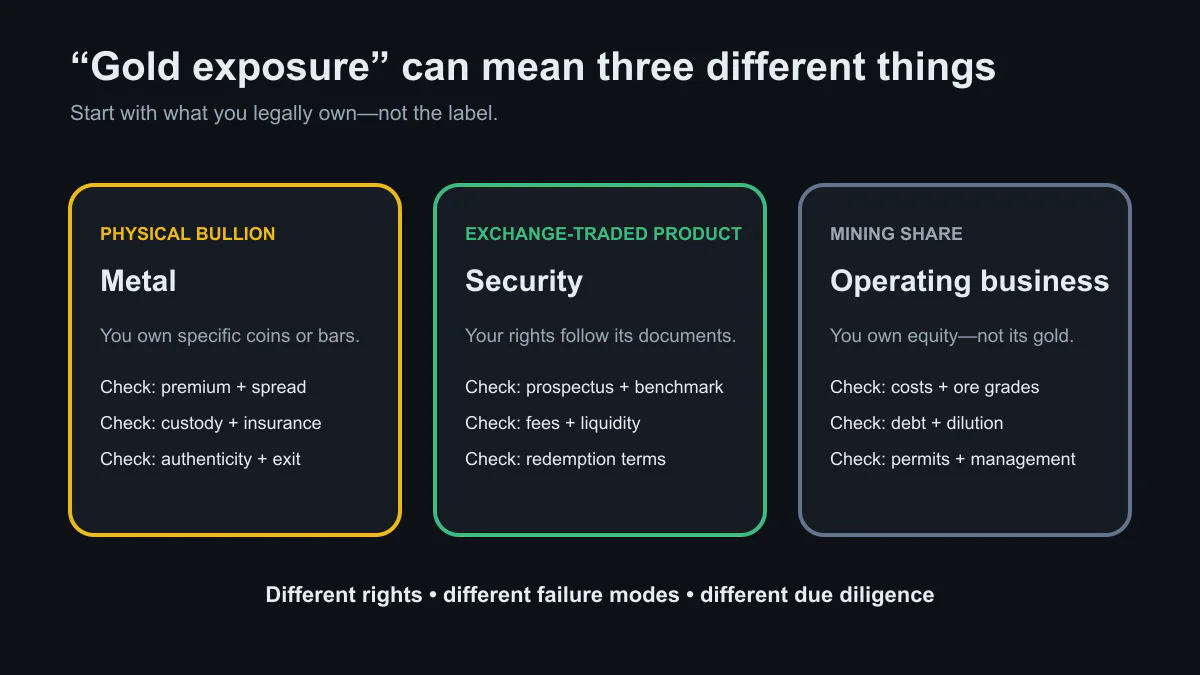
Image: GoldGram
Three products can all be described as “gold exposure” while giving their owners very different legal rights and risks. Physical bullion is metal. An exchange-traded product is a security whose structure must be read in its prospectus. A mining share is equity in a business that may benefit from a higher gold price but can also be hurt by costs, financing, geology, or management.
This guide is educational, not a recommendation or personalized financial advice.
Source check: 27 July 2026. Product terms, fees, prices, and tax treatment can change.
The comparison in one view
| Route | What the holder owns | Main price influence | Costs and frictions | Risks that are easy to miss |
|---|---|---|---|---|
| Physical bullion | Coins or bars, directly or through a custodian | Gold price plus the local dealer premium or discount | Dealer spread, delivery, storage, insurance, assay | Counterfeit product, disputed title, theft, costly resale |
| Exchange-traded gold product | Shares in a trust, fund, note, or other security | The product’s stated benchmark and structure | Expense ratio, brokerage costs, bid-ask spread, premium or discount to net asset value | Product may use futures, debt, or a trust structure rather than give retail holders a right to redeem metal |
| Mining equity | Shares in a company | Metal prices plus production, costs, reserves, financing, and execution | Trading costs; possible dilution; corporate taxes and royalties affect the business | A mine can underperform even when gold rises |
Physical bullion
The U.S. Mint defines bullion coins as investment-grade coins valued by precious-metal weight and fineness. Its bullion pages also explain that coins reach the public through dealers and trade at the metal price plus a premium. That premium may not be recovered at resale.
Before buying, record the exact product, gross weight, fine-metal content, unit price, all fees, delivery terms, storage arrangement, and the dealer’s written buy-back quote. The joint CFTC and FINRA physical-metals advisory warns that dealers sell above spot and buy below it, and that storage, insurance, commissions, and inflated markups can materially change the economics.
Direct possession removes reliance on a fund issuer, but it does not remove dealer, authentication, storage, theft, or resale risk. Allocated vault storage also introduces a custodian and contract that must be checked.
Exchange-traded gold products
“Gold ETF” is often used as a catch-all. In practice, a listed product may be a physical-metal trust, a fund using futures, an exchange-traded note backed by an issuer’s credit, or another structure. Those distinctions affect tracking, taxes, counterparty exposure, and redemption rights.
Read the prospectus rather than the label. Confirm:
- the legal structure and ticker;
- the benchmark and whether returns are spot-, futures-, or company-linked;
- how assets are held and audited;
- whether ordinary shareholders can redeem for metal;
- annual expenses and other costs;
- circumstances in which shares can trade above or below net asset value.
The SEC’s ETF investor bulletin explains that exchange prices can differ from net asset value and that exchange-traded commodity products and notes can have features unlike conventional stock-and-bond ETFs.
Mining shares
A miner owns leases, equipment, permits, contracts, liabilities, and a plan to extract ore. Gold is a revenue input, not the shareholder’s property. Higher prices may widen an operating margin, but fuel, labor, grades, recovery rates, royalties, currency moves, capital spending, and dilution can offset that effect.
Use the company’s latest audited filing and technical report, not a promotional presentation alone. For U.S. registrants, SEC EDGAR provides annual, quarterly, current, and technical-report filings. Compare reported revenue and cash flow with company-defined measures such as all-in sustaining cost; those measures are not standardized across every issuer.
A neutral selection method
First identify the exposure being evaluated: direct metal ownership, a tradable security intended to track a benchmark, or an operating company. Then compare the full cost of entry and exit, liquidity under stress, custody or issuer dependence, tax questions for the holder’s jurisdiction, and the largest plausible loss.
No route is universally preferable. The defensible conclusion is narrower: do not compare them as though they were the same instrument.
Primary and authoritative sources
- U.S. Mint: bullion coins
- CFTC and FINRA: questions to ask before buying physical metals
- SEC: ETF investor bulletin
- SEC: EDGAR company filings
goldbulliongold ETPmining stocksbuying guideprecious metals