Gold Purity Explained: Karats, Fineness, and Hallmarks
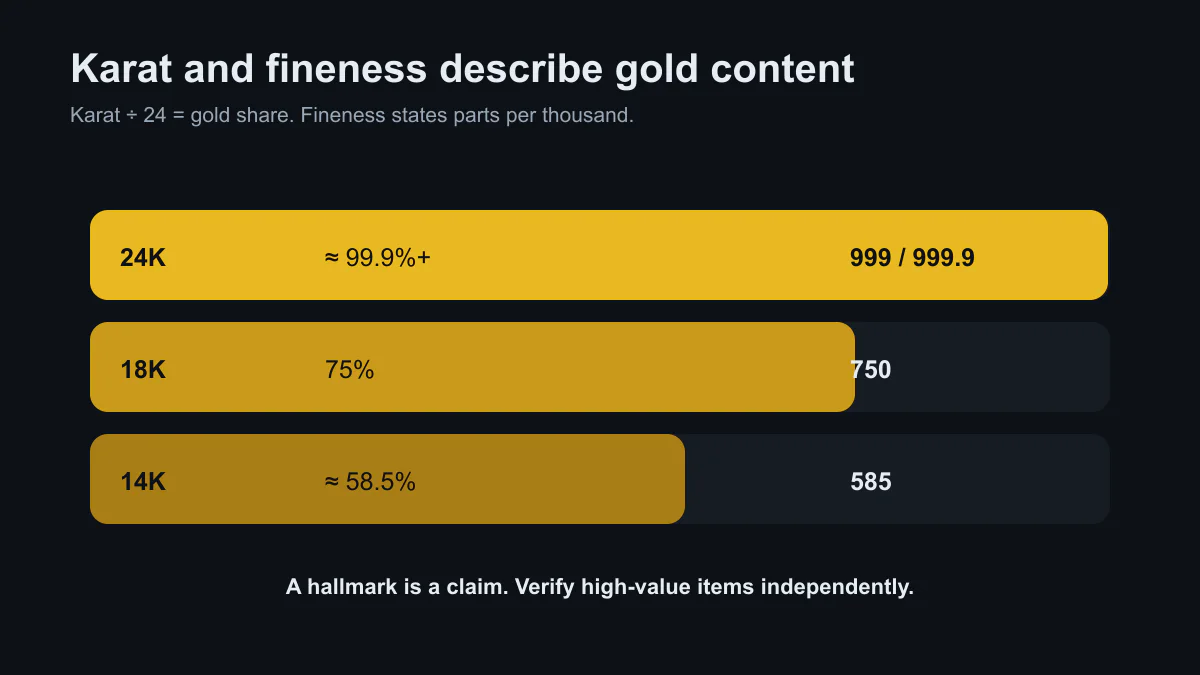
Image: GoldGram
Gold purity describes how much of an alloy is gold. Karats express that share in twenty-fourths; fineness expresses it in parts per thousand. Both are useful, but neither a color nor a tiny stamp proves that an item is genuine.
Source check: 27 July 2026. Marking rules and common practices vary by jurisdiction.
Karats
The karat calculation is:
gold percentage = karat / 24 × 100
| Mark | Mathematical gold share | Common fineness equivalent |
|---|---|---|
| 24K | 100% in the 24-part system | 999 or 999.9 is common for refined bullion |
| 22K | 91.67% | 916 or 917 |
| 18K | 75% | 750 |
| 14K | 58.33% | 583 or 585 |
| 10K | 41.67% | 417 |
| 9K | 37.5% | 375 |
The table gives mathematical or common equivalents, not an assay of a particular item. For example, the U.S. Mint states that a one-ounce American Gold Eagle is 91.67% gold alloy but contains a full stated troy ounce of fine gold because its gross weight is greater than one ounce. The .9999-fine American Buffalo uses a different composition.
Fineness
Fineness is the fine-metal fraction multiplied by 1,000. An item marked 750 claims 750 parts gold per 1,000 parts alloy, or 75%. To estimate fine-gold weight:
fine-gold weight = gross weight × fineness / 1,000
Use consistent units. A troy ounce is not the same as an avoirdupois ounce, and stones, clasps, solder, or non-gold components may be included in a jewelry item’s gross weight.
What a hallmark does and does not prove
The FTC’s U.S. consumer guidance says to look for a karat quality mark and, near it, the name or registered trademark of the company standing behind that mark. That makes a mark useful evidence about what the seller represents.
It is not conclusive authentication. Marks can be missing, worn, incorrect, or forged. A valuable purchase may justify:
- a written invoice naming the item, karat or fineness, weight, and seller;
- inspection for a responsible maker’s or sponsor’s mark;
- a calibrated scale and dimension check against an official specification;
- non-destructive testing by a qualified independent professional;
- an assay when the value and transaction terms justify destructive testing.
Testing methods have limitations. Surface testing may miss a plated core; electronic and X-ray fluorescence readings depend on calibration, geometry, and operator technique.
Solid, hollow, filled, and plated are different
Purity and construction answer different questions. Under the FTC’s consumer guidance, “solid gold” means the item is not hollow; the accompanying karat mark states the alloy’s gold content. Gold-plated, gold-filled, gold-overlay, and rolled-gold-plate products have gold applied over another metal and should not be valued as if their full weight were that karat alloy.
For bullion, start with the issuing mint’s specification and compare exact weight, dimensions, design details, and security features. For jewelry, construction, workmanship, gemstones, brand, and resale channel can matter alongside melt value.
A safer buying record
Keep a photo, invoice, measured weight, dimensions, marks, test method, tester identity, and return terms. If a seller will not state the fine-metal content or all-in price in writing, the uncertainty belongs in the valuation.
Primary and authoritative sources
- FTC: buying platinum, gold, and silver jewelry
- FTC: Jewelry Guides
- U.S. Mint: bullion coin specifications
- U.S. Mint: bullion consumer awareness
goldgold puritykaratsfinenesshallmarksprecious metals education